Optimize your ads for
profit, not revenue.

POAS measures the real profit you make on every €1 of ad spend - not the gross revenue ROAS reports back to you.

The POAS formula
Profit from ads
Ad spend
Above 1 = profit Below 1 = loss
€400M+
Sales generated for clients
120+
eCommerce brands
10+ years
Experience in performance marketing
100%
Your data and accounts stay yours

What is POAS?

POAS (Profit On Ad Spend) shows how much real profit every €1 of ad spend brings in. Unlike ROAS, which only counts revenue, POAS subtracts your cost of goods (COGS) and works from the margin you actually keep.

In short: ROAS tells you how much you sell. POAS tells you how much you keep.

Out of a sale worth€10,000
Cost of goods (COGS)€5,000
Ad spend€2,000
Real profit€3,000
POAS = Profit ÷ Ad spend1.5×

POAS vs ROAS -
what's the difference?

ROAS counts revenue. POAS counts profit - and sometimes the two tell you the exact opposite.

ROAS · what you see
Revenue from ads€10,000
Ad spend€2,000
5×looks excellent
POAS · what's actually happening
Gross profit (after COGS)€800
Ad spend€2,000
0.4×you lose money
on every order

An illustrative example: a 5× ROAS can hide a POAS below 1 whenever the margin is thin.

Get your free POAS audit

ROAS sees revenue.
POAS sees profit.

Two campaigns with an identical ROAS can return completely different profit. The difference comes down to cost of goods and real margin - exactly what ROAS ignores.

ROAS = Revenue ÷ Ad spend
POAS = Profit ÷ Ad spend
Gross revenue Profit

Why should you focus
on POAS?

Optimizing for profit changes every budget and bidding decision, not just the reports.

Decisions built on profit, not vanity metrics

You allocate budget by real profit, not by a ROAS that only looks good in a report.

Budget flows to the profitable products

High-margin products get more budget; the unprofitable ones get capped or excluded.

Scale without scaling your losses

You only raise budgets on the segments with a proven, positive POAS.

Less wasted budget

You can see straight away which categories and products burn money without returning profit.

I want these results →

POAS works at
every level.

From a single product up to the whole account, the same logic applies: budget follows profit.

Product level

Every product gets its own profit label

Custom labels split the catalog into margin tiers. Budget and bids go to the products that make money, not to the ones with high volume and a thin margin.

High margin · high-POAStarget ≥ 1.5×
Mid margintarget ≥ 1×
Low margin · low-POASmonitored
Campaign level

Real POAS per campaign, not just ROAS

See exactly which campaigns and ad groups bring in profit and which ones only spend budget. Two campaigns with a healthy ROAS can sit at opposite ends on POAS.

CampaignROASPOASStatus
Shopping · Bestsellers4.2×2.1×profit
PMax · General5.8×0.7×loss
Search · Brand9.1×3.4×profit
Meta · Retargeting3.1×1.4×profit
Account level

Real profit, across every channel

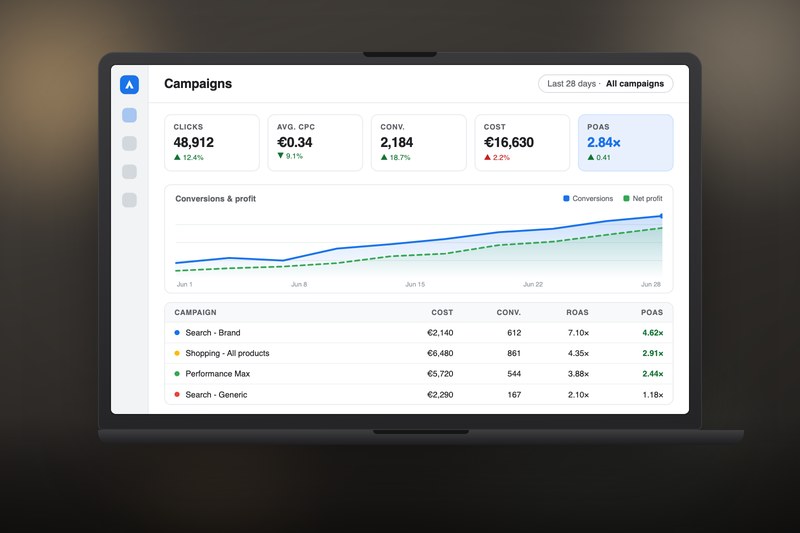
One dashboard with your POAS on Google Ads, Meta and Shopping, plus how it moves month over month - not just gross revenue.

POAS report · Live
POAS Google Ads3.4×
POAS Meta Ads2.7×
Change vs. last month+18% ↗

How does a
POAS strategy work?

A clear process, from raw data to campaigns optimized for profit.

Tracking audit & validation

We check that every conversion is measured correctly in Google Ads, Meta and GA4.

Margin mapping

We collect COGS and real margin per product or category.

Performance labels in the feed

We tag every product by profitability tier.

Restructuring around profit

Budgets and bids move to the segments with a positive POAS.

Get your free POAS audit

Who is POAS
a good fit for?

POAS pays off most for stores with mixed margins and a meaningful ad budget.

POAS is a good fit if...The ideal profile for profit-based optimization
  • You carry dozens or hundreds of products with different margins
  • You run Google Ads and/or Meta on a meaningful monthly budget
  • Your ROAS looks good, but profitability isn't matching expectations
  • You have cost of goods (COGS) data, at least at category level
  • You want to scale on real profit rather than on volume
POAS can wait if...We get your data foundations right first
  • You have no cost of goods or margin data
  • Tracking is inaccurate and can't be fixed any time soon
  • You sell one category at a uniform margin - ROAS is enough
  • Sales volume is too low for the data to mean much
  • You're early on and don't have a settled campaign structure yet

POAS in practice

Optimizing for profit changes where the campaigns go - here's what we've delivered for clients.

Client A
FashionGoogle Shopping
2.4×Final POAS
+41% net profit · -28% wasted budget

A 6× ROAS looked excellent, but 40% of the budget was going to products with margins under 8%. We restructured them around profit.

Client B
BeautyPerformance Max
3.1×POAS on margin
+34% gross profit from ads

PMax was allocating budget by volume, not by margin. We split it into asset groups by profitability tier.

Client C
Cross-channelGoogle + Meta
+44%Cross-channel efficiency
POAS Google 3.2× · Meta 2.6×

A single POAS target across both platforms, with unified reporting on real profit.

Figures representative of typical results from our portfolio; the full case studies include data verified with each client.

Frequently asked questions
about POAS

What is POAS?
POAS (Profit On Ad Spend) is the metric that measures the gross profit generated for every €1 you put into paid advertising. Unlike ROAS, which reports gross revenue, POAS factors in cost of goods (COGS) and your real margin - giving you an honest picture of how profitable your Google Ads, Meta Ads and Google Shopping campaigns actually are.
What does Profit On Ad Spend mean?
Profit On Ad Spend (POAS) is the gross profit your paid ads generate, measured against what you spent to get it. The formula is: POAS = Gross profit from ads ÷ Ad spend. A POAS of 1.5× means that for every €1,000 you spent on ads, you generated €1,500 in gross profit.
What's the difference between POAS and ROAS?
ROAS measures the gross revenue generated per €1 of advertising (for example, a 5× ROAS = €5,000 in revenue for €1,000 of spend). POAS measures the gross profit generated per €1 of advertising - taking cost of goods, real margin and other variable costs into account. A 5× ROAS can hide a negative POAS if the product margin sits below 20%.
Is POAS better than ROAS?
POAS is more useful than ROAS for online stores whose product categories carry different margins, because it strips the distortion out of the reporting. ROAS is enough when every product sits at a similar margin and tracking is straightforward. As the business grows and the catalog gets more complex, POAS becomes a requirement for scaling profitably.
How is POAS calculated?
POAS = Gross profit generated by ads ÷ Ad spend. Gross profit is calculated as: revenue attributed to ads − cost of goods sold (COGS). For example: if your ads generated €10,000 in sales and COGS is €7,000 (a 30% margin), gross profit is €3,000. If you spent €2,000 on ads, POAS = 3,000 ÷ 2,000 = 1.5×.
What data do you need to implement POAS?
You'll need: cost of goods (COGS) per SKU or category, selling price, gross margin, an up-to-date product feed for Google Merchant Center or Meta Catalog, accurate tracking in Google Ads / Meta Ads / GA4, and your conversion attribution data. Without accurate tracking, there's no reliable way to implement POAS.
Can POAS be used in Google Ads?
Yes. You apply POAS in Google Ads by segmenting Shopping and Performance Max campaigns with profitability custom labels in the feed, bidding differently per margin tier, and excluding or capping products with a negative POAS. There's no native "POAS" setting in Google Ads - it's an optimization framework built on your own margin data, wired into your campaigns.
Can POAS be used in Facebook Ads and Meta Ads?
Yes, but indirectly. Meta Ads doesn't calculate POAS natively. POAS analysis for Meta works by matching the sales attributed to your Meta campaigns against the margin data in your eCommerce platform or ERP. From there you can make budget, creative testing and audience segmentation decisions based on profitability rather than on ROAS or gross revenue.
How does POAS help with product feed optimization?
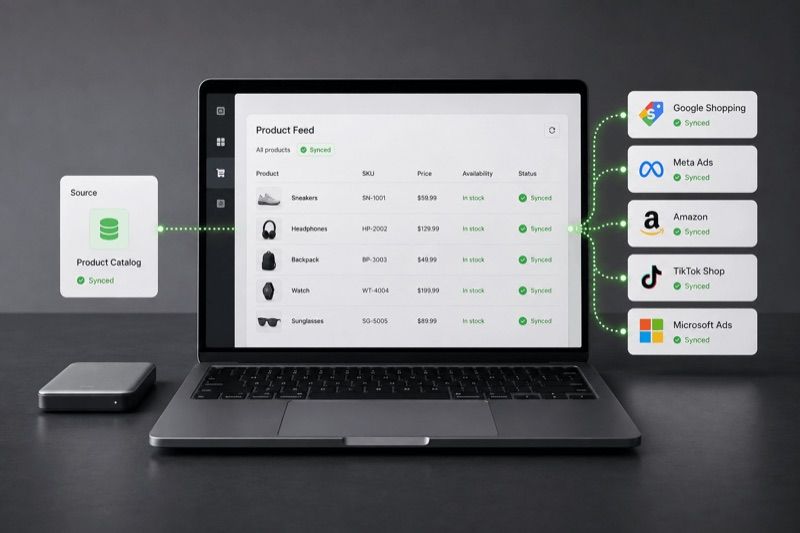
POAS and feed management are directly connected. By adding profitability custom labels to your Google Shopping or Meta Catalog product feed, you can build separate campaigns per margin tier and assign different bids and budgets to each. High-margin products get more visibility and bigger budgets, while unprofitable ones are controlled or excluded from campaigns.
Do I need POAS if my ROAS is already good?
A good ROAS doesn't guarantee profitability. If your catalog holds products at different margins, you may well have an excellent ROAS on unprofitable categories and a modest one on your high-margin lines. POAS corrects that distorted picture and shows you where you're genuinely making money.
When should an eCommerce store switch from ROAS to POAS?
The right moment to move to POAS is when: your catalog carries different margins across categories or products, monthly ad spend is significant, overall profitability isn't growing in step with sales, or you want to scale budgets safely without widening your losses. A profitability audit of your existing campaigns will show quickly whether POAS is needed.
What if I don't have cost of goods data?
Without cost (COGS) data, POAS can't be calculated correctly. In that case we'd recommend collecting and structuring your margin data at category level first - it doesn't have to be per SKU - which already allows a partial but genuinely valuable POAS implementation. BigConvert can help structure that data together with your team.

Official partners & certifications

Meta Business Partner
Google Partner Premier 2024
Google Comparison Shopping Premium Partner
Google Comparison Shopping
Let's get started

Are your ads making money
or eating your profit?

Ask for a free POAS audit. We'll go through the real profit on your Google Ads, Meta Ads and Google Shopping together - and find where the budget is leaking.

Get your free POAS audit +40 767 461 111

No commitment · Reply within 24h · Full audit, free