
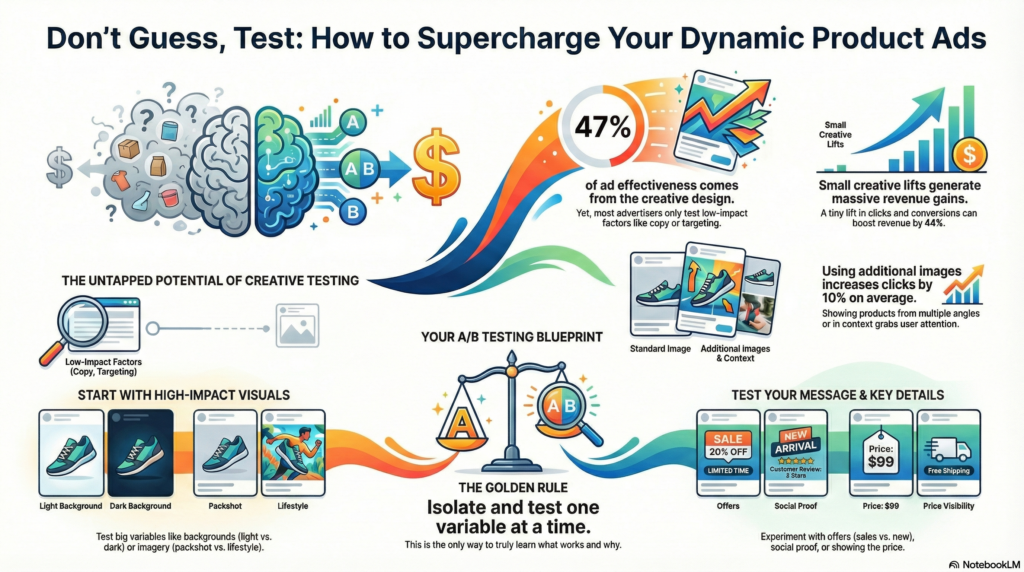
In the dynamic world of digital advertising, capturing attention and driving conversions depends not only on smart algorithms but also on the creative elements of your ads. While Facebook’s algorithm excels at matching products to individual interests, the true driver of success for Dynamic Product Ads (DPAs) often lies in creative optimisation. Research shows that 47% of advertising effectiveness stems from design, underlining the critical role creative elements play in persuading users to stop scrolling and engage.
The Fundamentals of A/B Testing for DPAs
A/B testing is an essential strategy to discover the most effective creative variations. It involves comparing a control ad version against one with a single changed element to accurately isolate what drives better performance. Changing only one variable at a time is crucial to precisely identify which aspects truly influence user behavior.
There are five key creative variables to test:
- The Background: Experiment with broad visual elements such as light versus dark backgrounds, saturated versus muted colors, or patterns versus flat colors. These factors affect the overall appeal and can effectively grab attention.
- The Ad Message: Test different value propositions including unique selling points, social proof (ratings, reviews), shipping information, or discount offers to determine what resonates best with your audience.
- The Details: Small design choices such as displaying discounts as percentages (%) versus currency ($), including brand logos, or adding price splashes can influence perceptions of value and trust.
- The Text: Vary font size, casing (uppercase vs. lowercase), and text placement (center or corners) to optimise readability and impact during quick scrolling.
- Minor Variables: Explore subtle tweaks such as emojis or word synonyms. Even these small changes can sometimes double conversion rates.
Leveraging Product Feeds and Additional Images
Beyond manual testing, leveraging product feed data automates and significantly enhances creative optimisation. Feeds enable dynamic updates such as adding brand names, campaign tags, or percentage discounts directly onto product images, providing real-time visual cues that boost Click-Through Rates (CTR). For example, case studies demonstrate that these automated enhancements can increase CTR from typical 2–3% levels up to 4–6%.
Effective inventory management through feeds is also vital: products with limited availability can be automatically excluded, ensuring your ad spend focuses on items with higher conversion potential.
The Power of Additional Images
DPAs traditionally rely on single “packshot” images with plain backgrounds. However, incorporating multiple images that showcase several angles or lifestyle contexts offers richer detail that drives stronger engagement:
- CTR Increase: Using multiple images in catalog ads increases CTR by an average of 10%.
- Return on Ad Spend (ROAS): Bottom-funnel ads featuring additional lifestyle or angle images experience a remarkable 33% increase in ROAS.
- Lifestyle Appeal: Combining product shots with photos showcasing products in real-life settings helps consumers imagine owning the product, enhancing emotional connection.
The Compound Benefit of Creative Optimisation
Creative optimisation focuses on making existing content more effective rather than simply increasing volume. Even modest improvements in performance metrics can cumulatively generate significant revenue growth:
- Click-Through Rate (CTR): Raising CTR from 2% to 2.4% results in 20% more website traffic using the same advertising budget.
- Conversion Rate: A 0.6% increase in conversion rate adds another 20% more sales from that increased traffic.
- Revenue Growth: Combining these improvements can increase total revenue by 44% without any additional ad spend.
Think of it like tuning a racing car: the algorithm is the powerful engine, but creative optimisation adjusts the aerodynamics, tyre weight, and steering responsiveness — small but critical refinements that shave off seconds and win the race.
Tailoring Creative to Platform-Specific Behaviours
Each advertising platform demands creatives that align with its users’ behaviours and content consumption habits:
- Meta (Facebook & Instagram): Utilises advanced A/B testing and “Dynamic Creative” tools that automatically shift budgets toward top-performing ad combinations.
- TikTok: Success depends heavily on capturing attention within the initial three seconds. Content should feel native, unpolished, and authentic rather than like a highly polished advertisement.
- Pinterest: Requires vertical images in a 2:3 ratio paired with keyword-rich descriptions to leverage its discovery-focused user base effectively.
- Snapchat: Favors fast-paced, visually striking ads with a clear product focus, catering to users with short attention spans.
Preventing and Overcoming Ad Fatigue
DPAs often run as “always-on” campaigns, which can lead to ad fatigue—a decline in user response due to repeated exposure. Consistently refreshing ads via the product feed helps ensure creatives remain fresh and relevant, sustaining user interest over time.
The product feed acts like a personal shopper: unlike static ads that remain the same for every viewer, feed-driven ads can recognise a shopper’s preferences, available discounts, and product details—dynamically tailoring the creative to each user’s unique context.
Conclusion
Optimising ad creatives for Dynamic Product Ads is a powerful lever for enhancing advertising performance. By systematically A/B testing variables such as backgrounds, ad messages, design details, and text placements, advertisers can identify the most effective elements that drive conversions. Leveraging product feeds further amplifies this effect by automating visual enhancements, managing inventory relevance, and refreshing creatives to combat ad fatigue.
Additionally, incorporating multiple product images—especially lifestyle shots—and tailoring creatives for each platform’s unique user behaviour enables deeper engagement with audiences, dramatically boosting CTR and ROAS.
Ultimately, combining data-driven creative tuning with sophisticated testing and feed automation can increase revenue by nearly half without additional ad spend—a clear demonstration that in digital advertising, how you present your product is just as important as what you offer.